WC Archivetag:www.openthefuture.com,2023:/wcarchive//22007-07-08T02:43:47ZThe collection of WorldChanging posts by Jamais Cascio.Movable Type 4.37Earth Day Voices: Jamais Casciotag:www.openthefuture.com,2007:/wcarchive//2.85252007-04-22T16:21:55Z2007-07-08T02:43:47ZFour Futures for the Earth by Jamais Cascio Never trust a futurist who only offers one vision of tomorrow. We don't know what the future will hold, but we can try to tease out what it might. Scenarios, which combine...Jamais Casciohttp://www.openthefuture.com
Four Futures for the Earth
by Jamais Cascio
Never trust a futurist who only offers one vision of tomorrow.
We don't know what the future will hold, but we can try to tease out what it might. Scenarios, which combine a variety of important and uncertain drivers into a mix of different -- but plausible -- futures, offer a useful methodology for coming up with a diverse set of plausible tomorrows. Scenarios are not predictions, but examples, giving us a wind-tunnel to test out different strategies for managing large, complex problems.
And there really isn't a bigger or more complicated problem right now than the incipient climate disaster. Today, there seems to be two schools of thought regarding the best way to deal with global warming: the "act now" approach, demanding (in essence) that we change our behavior and the ways that our societies are structured, and do it as quickly as possible, or else we're boned; and the "techno-fix" approach, which says (in essence) don't worry, the nano/info/bio revolution that's just around the corner will save us. Generally, the Worldchanging approach is to emphasize the first, with a sprinkle of the second for flavor (and as backup).
The thing is, these are not mutually-exclusive propositions, and success or failure in one doesn't determine the chance of success or failure in the other. It's entirely possible that we will change our behavior/society/world (ahem), and also come up with fantastic new technologies; it's also possible that we'll stumble on both paths, neither fixing things in time nor getting our hands on the tools we could use to repair the worst damage.
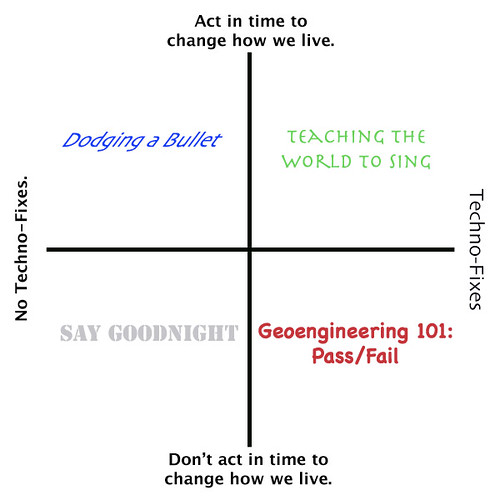
To a futurist, a pair of distinct, largely independent variables just begs to be turned into a scenario matrix. So let's give in, and take a brief look a the four scenarios the combinations of these two paths create:
Dodging a Bullet 2037: It's amazing how fast we went from "is this real?" to "what can we do?" to "let's do it now." There was no silver bullet, no green leap forward, just a billion quiet decisions to act. People made better, smarter choices, and the headlong rush to disaster slowed; encouraged by this, we started to focus our investments and social energy into solving this problem, and eventually (but much faster than we'd dared hope!) the growth of atmospheric carbon stopped. There's still too much CO2 in the air, and we know we're going to be dealing with a warming climate for awhile still, but the human species actually managed to choose to avoid killing itself off.
This is a world in which civil society begins to focus on averting climate disaster as its primary, immediate task, even at the cost of some economic growth and general technological acceleration. Most governments and institutions curtail research and development without direct climate benefits, leading to a world of 2037 that's nowhere near as advanced as futurists and technology enthusiasts had expected. A succession of environmental disasters linked (in the public mind, at the very least) to global warming -- killing hundreds of thousands, and leaving tens of millions as refugees -- gave added impetus to a world-wide effort; by 2017, a clear majority of the world's population was willing to do anything necessary to avoid the environmental collapse that many scientists saw as nearly inevitable. One popular slogan for the climate campaign was "we could be the best, or we could be the last."
Teaching the World to Sing 02037: I stumbled across a memory archive from twenty years ago, before the emergence of the Chorus, and was shocked to see the Earth as it was. Oceans near death, climate system lurching towards collapse, overall energy flux just horribly out-of-balance. I can't believe the Earth actually survived that. I had assumed that the Chorus was responsible for repairing the planet, but no -- We told me that, even by 02017, the Earth's human populace was making the kind of substantive changes to how it lived necessary to avoid real disaster, and that 02017 was actually one of the first years of improvement! What the Chorus made possible was the planetary repair, although We says that this project still has many years left, in part because We had to fix some of We's own mistakes from the first few repair attempts. The Chorus actually seemed embarrassed when We told me that!
This is a world in which immediate efforts to make the social and behavioral changes necessary to avoid climate disaster make possible longer-term projects to apply powerful, transformative technologies (such as molecular manufacturing and cognitive augmentation) to the problem of stabilizing and, eventually, repairing the broken environment. It's not quite a Singularity, but is perhaps something nearly as strange: a world that has come to see few differences between human systems and natural/geophysical systems. "We are Gaia, too," the aging (but quite healthy) James Lovelock reminded us in 2023. And Gaia is us: billions of molecular-scale eco-sensors and intelligent simulations give the Earth itself an important voice in the global Chorus.
Geoengineering 101: Pass/Fail 2037: The Hephaestus 2 mission reported last week that it had managed to stabilize the wobble on the Mirror, but JustinNN.tv blurbed me a minute ago that New Tyndall Center is still showing temperature instabilities. According to Tyndall, that clinches it: we have another rogue at work. NATO ended the last one with extreme prejudice (as dramatized in last Summer's blockbuster, "Shutdown" -- I loved that Bruce Willis came out of retirement to play Gates), but this one's more subtle. My eyecrawl has some bluster from the SecGen now, saying that "this will not stand," blah blah blah. I just wish that these boy geniuses (and they're all guys, you ever notice that?) would put half as much time and effort into figuring out the Atlantic Seawall problem as they do these crazy-ass plans to fix the sky.
This is a world in which attempts to make the broad social and behavioral changes necessary to avoid climate disaster are generally too late and too limited, and the global environment starts to show early signs of collapse. The 2010s to early 2020s are characterized by millions of dead from extreme weather events, hundreds of millions of refugees, and a thousand or more coastal cities lost all over the globe. The continued trend of general technological acceleration gets diverted by 2020 into haphazard, massive projects to avert disaster. Few of these succeed -- serious climate problems hit too fast for the more responsible advocates of geoengineering to get beyond the "what if..." stage -- and the many that fail often do so in a spectacular (and legally actionable) fashion. Those that do work serve mainly to keep the Earth poised on the brink: bioengineered plants that consume enough extra CO2 and methane to keep the atmosphere stable; a very slow project to reduce the acidity of the oceans; and the Mirror, a thousands of miles in diameter solar shield at the Lagrange point between the Earth and the Sun, reducing incoming sunlight by 2% -- enough to start a gradual cooling trend.
Say Goodnight 2030-something. Late in the decade, I think. Living day-to-day makes it hard to keep track of the years. The new seasons don't help -- Stormy, Still Stormy, Hellaciously Stormy, and Blast Furnace -- and neither does the constant travel, north to the Nunavut Protectorate, if it's still around. I hear things are even worse in Europe, if you can believe that. I don't hear much about Asia anymore, but I suppose nobody does now. The Greenland icepack went sometime in the last few years, and I hear a rumor that Antarctica is starting to go now. Who knows? I still see occasional aircraft high overhead, but they mostly look like military planes, so don't get your hopes up: they're probably from somebody who thinks it's still worth it to fight over the remaining oil.
This is a world in which we don't adopt the changes we need, and technology-based fixes end up being too hard to implement in sufficient quantity and scale to make a real difference. Competition for the last bit of advantage (in economics, in security, in resources) accelerates the general collapse. Things fall apart; the center does not hold; mere anarchy is loosed upon the world.
Pick your future.
Jamais Cascio co-founded Worldchanging, and wrote over 1,900 articles for the site during his tenure. He now works as a foresight and futures specialist, serving as the Global Futures Strategist for the Center for Responsible Nanotechnology and a Research Affiliate for the Institute for the Future. His current online home is Open the Future.]]>
What's Next: Jamais Casciotag:www.openthefuture.com,2006:/wcarchive//2.81122006-12-30T19:23:55Z2007-07-08T02:43:52ZAs a species, Homo sapiens isn't particularly good at thinking about the future. It's not really what we evolved to do. Our cognitive tools developed in a world where rapid and just-accurate-enough pattern recognition and situation analysis meant the difference...Jamais Casciohttp://www.openthefuture.com
Jamais Cascio is the co-founder of Worldchanging. He writes about the intersection of emerging technologies and cultural transformation, and specializes in the design and creation of plausible scenarios of the future. His current online presence lives at Open the Future.]]>
All Good Things...tag:www.openthefuture.com,2006:/wcarchive//2.70272006-04-01T02:51:01Z2007-07-08T02:20:09ZThis is my last post as a WorldChanging staffer. Few things in my life have made me happier, or prouder, than my work at WorldChanging. We have created something truly wonderful here -- and by "we," I mean all of...Jamais Casciohttp://www.openthefuture.com
This is my last post as a WorldChanging staffer.
Few things in my life have made me happier, or prouder, than my work at WorldChanging. We have created something truly wonderful here -- and by "we," I mean all of us: Alex Steffen, my partner in creating the site; the team of contributors, many of whom have become lasting friends of mine; the network of weblogs and allies that stimulate and extend our discussions; and, most of all, you folks who take the time to read WorldChanging. It's not often that one gets to have a hand in the creation of a movement that could change the world. I suspect that helping build this site will remain my calling card for years to come.
I'm not disappearing from the site entirely, mind you. My email here will still work, I'll still have a spot on the side-bar, and I will occasionally post items of interest. But we've done here what we set out to do, and it's time to see what I can do next.
I can't say where you'll see me next, in part because some of the opportunities that have arisen are not yet ready for public discussion. I can say that I'll be doing more direct consulting on the kinds of issues I've covered here, and have a couple of book ideas I intend to pursue. I will carry with me the lessons I've learned helping to bring this site into existence: we must make choices that better ourselves, better our communities, and better the world, even though those choices are rarely easy. For me, few decisions have been harder than this one.
It's the right time to do make this decision, however. The book is done, so Alex and the rest of the team will once again have more time to bring their diverse voices to the WorldChanging page. Sarah Rich has stepped into the role of Managing Editor with great enthusiasm. I feel quite confident that WorldChanging is about to move into an even better stage in its life, with the kind of variety of ideas and expanse of perspectives it needs to help reshape how we think about the world, its future, and our own capacities for change.
Thank you all for making the last two-and-a-half years simply incredible. See you in The Future...
Design a Mars Flyertag:www.openthefuture.com,2006:/wcarchive//2.70212006-03-31T00:05:24Z2007-07-08T02:20:09ZAttention, European university students (or their friends and families): how would you like to design an unmanned aerial vehicle for use on Mars? EUROAVIA (European Association of Aerospace Students) DeWo WG and the European Space Agency have kicked off a...Jamais Casciohttp://www.openthefuture.com
Attention, European university students (or their friends and families): how would you like to design an unmanned aerial vehicle for use on Mars?
EUROAVIA (European Association of Aerospace Students) DeWo WG and the European Space Agency have kicked off a competition, open to students at European universities specializing in aeronautics and/or space technologies, asking them to come up with a design plan for a UAV best suited for exploring the planet Mars.
The authors of the 25 best papers will be invited to participate in the three-week design workshop at ESA's research and technology centre (ESTEC). During the workshop they will create a preliminary design of a UAV for Mars with the assistance of specialists from the industry and other institutions. Selected participants will be hosted at no cost.
More information can be found at the Design Workshop 2006 site.
Although many of us at WorldChanging are Areophiles, the most appealing aspect of this program is the inclusion of university students in a potentially revolutionary space effort. As with other student competitions, such as the Cradle to Cradle Home Competition, the Solar Decathlon, and the Car of 2030 competition, the point isn't to get the best possible design, but to get the most innovative design -- ideas from people who haven't yet learned to listen when told that something is impossible.]]>
balloon as a flying probe before, and a lighter-than-air vehicle has some distinct advantages over a winged flyer: it's easier to pack onto a lander, and can go for weeks or months without having to worry about power. A balloon probe can't control where it goes, however, being subject to wind patterns.
There have been some interesting advances in UAV technologies of late, most notably the successful test of an entirely-solar-powered long-range flier. The much thinner atmosphere of Mars could be a problem, however, as a useable flier would need far larger wings to maintain lift. Still, ideally we'll see some combination of winged, powered fliers and lighter-than-air balloons in a planetary exploration fleet.
And maybe one of you will take us there.]]>
Culture Jamming the Tahoetag:www.openthefuture.com,2006:/wcarchive//2.70202006-03-30T22:05:11Z2007-07-08T02:20:08ZChevrolet has opened up a site asking visitors to create advertisements for its ginormous SUV, the Tahoe, using a collection of clips and soundtracks, as well as your own text. Thing is, there's no reason you have to make ads...Jamais Casciohttp://www.openthefuture.com
create advertisements for its ginormous SUV, the Tahoe, using a collection of clips and soundtracks, as well as your own text.
Thing is, there's no reason you have to make ads in favor of ginormous SUVs...
The good folks at Network-Centric Advocacy are collecting links to (and, where possible, recordings of) "Chevy Apprentice" ads talking about global warming and similar subjects. Here's an example. If you come up with a good one, be sure to post the link there -- and here, of course!
Enjoy!]]>
Can You Copyright the World?tag:www.openthefuture.com,2006:/wcarchive//2.70192006-03-30T00:59:55Z2007-07-08T02:20:08ZDocumentary filmmakers are in a particularly difficult position in terms of intellectual property, as most documentarians focus on lives of real people -- and modern life, especially in the US, Europe and Japan, is inundated with logos, music, background video...Jamais Casciohttp://www.openthefuture.com
Documentary filmmakers are in a particularly difficult position in terms of intellectual property, as most documentarians focus on lives of real people -- and modern life, especially in the US, Europe and Japan, is inundated with logos, music, background video and myriad other trademark and copyright concerns. Bound by Law?, a discussion of the intersection of fair use, public domain, copyright and documentary film -- done in a comic book format -- illustrates both the complexities that documentarians face and the broader struggle over how we can record modern life in all of its forms for posterity. Created by Keith Aoki, James Boyle and Jennifer Jenkins at the Duke University Center for the Study of the Public Domain, Bound by Law? is well-worth reading by anyone trying to understand how intellectual property rules affect our lives. Although it looks only at American regulations, many of the concepts it covers apply far more broadly.
The ongoing evolution of copyright laws in the industrialized world has served both to protect and to stymie creative artists. On the one hand, stronger and more explicit protection of copyright assures emerging artists that larger corporate entities can't simply take the artists' work; on the other hand, aggressive assertion of rights over material that is part of our common culture has a demonstrable negative impact on the creative abilities of artists. Although much of the debate online focuses on American laws, digital era copyright laws in Europe and Japan have evoked similar arguments, and the role of intellectual property laws in the relationship between industrialized and developing nations remains controversial. The solutions offered by groups like Creative Commons can go a long way to making the situation more reasonable, but they require positive action on the part of artists.]]>
participatory panopticon"-style technologies, especially as the more rudimentary versions of these technologies come to be used as ways to document events as they happen. It's likely, in fact, that the biggest roadblocks to more widespread adoption of "lifeblogging," "sousveillance" and other participatory panopticon tools will arise not from privacy concerns, but from intellectual property problems. Some will come from twisty legal passages, all alike, that label showing the recordings to others as "public presentation." Some will come from restrictions on recording hardware meant to stop "piracy" of copyrighted material by shutting down whenever songs or videos with digital restriction "watermarks" are captured, even in the background.
As Bound by Law? demonstrates, this is not an easily-resolved situation -- but it's one that is increasingly important to us all.]]>
Demographic Mashuptag:www.openthefuture.com,2006:/wcarchive//2.70182006-03-29T22:24:59Z2007-07-08T02:20:08ZAnalyGIS and SRC, both of whom work on various tools for studying markets and communities, have teamed up to build a demographic study tool combining Google Maps (surprise) and 2000 US Census data. Click on a spot in the US,...Jamais Casciohttp://www.openthefuture.com
AnalyGIS and SRC, both of whom work on various tools for studying markets and communities, have teamed up to build a demographic study tool combining Google Maps (surprise) and 2000 US Census data. Click on a spot in the US, then select either basic census information (ethnic distribution, sex parity, and income averages) or housing information (owners vs. renters, housing value, age of units) within one, three and five miles of your target click. You can also enter an address directly.
They describe this as primarily a proof-of-concept exercise, so there's no telling when it will disappear. Still, for those of us who want a better way to access demographic information quickly and visually, this works pretty well. Since it's based on Google Map's public APIs and open access census data, it should also be relatively simple to rebuild should this one go away.
(Thanks, Joe Willemssen!)]]>
Wired's Climate Disaster Interviewstag:www.openthefuture.com,2006:/wcarchive//2.70172006-03-29T22:06:12Z2007-07-08T02:20:08ZWired News has posted a series of interviews with the authors of three recent books on global warming and what we can do about it. The three interviews -- with Tim Flannery, author of The Weather Makers: How Man is...Jamais Casciohttp://www.openthefuture.com
Wired News has posted a series of interviews with the authors of three recent books on global warming and what we can do about it. The three interviews -- with Tim Flannery, author of The Weather Makers: How Man is Changing the Climate and What It Means for Life on Earth, Lester R. Brown, author of Plan B 2.0 (described, with links, here), and Elizabeth Kolbert, author of Field Notes From a Catastrophe: Man, Nature, and Climate Change (based on her incredible series of articles at the New Yorker) -- are brief but quite compelling.
These interviews are part of a growing body of literature aimed at what we might call the "eyes now open" audience: people who weren't denialists about climate disaster, but thought it was something for future generations to worry about, was something that had to do with the ozone layer, or wasn't that big of a deal anyway. In the post-Katrina world, these folks, who potentially are a majority of the American public, are waking up to the reality that global warming-induced climate disruption is happening now, and that we have to act fast if we are to head off the worst possible outcomes.]]>
Rice, Climate and "Effects Mitigation"tag:www.openthefuture.com,2006:/wcarchive//2.70162006-03-28T22:08:58Z2007-07-08T02:20:08ZEven in the best case climate scenarios, the planet is going to face years of rising temperatures and some pretty unpleasant (and often tragic) results across much of the world. Given that many of the worst-hit locations will be in...Jamais Casciohttp://www.openthefuture.com
Even in the best case climate scenarios, the planet is going to face years of rising temperatures and some pretty unpleasant (and often tragic) results across much of the world. Given that many of the worst-hit locations will be in the poorer nations, it's important that we spend some time thinking about ways not just to mitigate the process of climate disruption -- that is, to reverse it -- but also to mitigate its effects. This isn't "adaptation," it's harm reduction; think of it as suppressing the worst symptoms while fighting to cure the disease.
Changes to temperature and rainfall patterns will affect many elements of how we live, but one of the most important will be agriculture. Staple foods that have been grown in various regions for hundreds or thousands of years will be harder and harder to cultivate; it's highly likely that global warming will lead to repeated crop failures and famine. Fortunately, some organizations have begun to consider this scenario, and to work on responses. This month, the International Rice Research Institute announced a new plan to do just that:
"Clearly, climate change is going to have a major impact on our ability to grow rice," Robert S. Zeigler, IRRI director general, said. "We can't afford to sit back and be complacent about this because rice production feeds almost half the world's population while providing vital employment to millions as well, with most of them being very poor and vulnerable."
For these reasons, Dr. Zeigler announced at the workshop that IRRI  in an unprecedented move  was ready to put up US$2 million of its own research funds as part of an effort to raise $20Â25 million for a major five-year project to mitigate the effects of climate change on rice production. "We need to start developing rice varieties that can tolerate higher temperatures and other aspects of climate change right now," he said.
]]>
smart breeding" to cross-breeding of rice species to limited genetic manipulation.
Finding the right balance between climate change effects mitigation and process mitigation isn't easy. Put too much effort into figuring out how to live with the effects, and the temptation grows to simply accept the changes that have happened, especially if the effects aren't as bad in (say) the United States as they are in (say) the Philippines. Put too little effort in, however, and it will be difficult to focus on developing the necessary innovations and implementations for stopping and, eventually, reversing the climate disaster. Effects mitigation programs that focus on helping the poorest and most vulnerable populations handle global warming seems a reasonable compromise; the IRRI project will be a useful model to watch.]]>
The Open Future: Open Source Scenario Planningtag:www.openthefuture.com,2006:/wcarchive//2.70132006-03-28T01:22:55Z2007-07-08T02:20:08ZScenario methodology is a powerful tool for thinking through the implications of strategic choices. Rather than tying the organization to a set "official future," scenarios offer a range of possible outcomes used less as predictions and more as "wind tunnels"...Jamais Casciohttp://www.openthefuture.com
this way?) We talk about scenarios with some frequency here, and several of us have worked (and continue to work) professionally in the discipline.
With its genealogy reaching back to Cold War think tanks and global oil multinationals, however, scenario planning tends to be primarily a tool for corporate and government planning; few non-profit groups or NGOs, let alone smaller communities, have the resources to assemble useful scenario projects or (more importantly) follow the results of the scenarios through the organization. Scenario planning pioneer Global Business Network has made a real effort to bring the scenario methodology to non-profits (disclosure: I worked at GBN and continue to do occasional projects for them), but we could take the process further: we can create open source scenarios. I don't just mean free or public scenarios; I mean opening up the whole process.
Let's see what this would entail.]]>
biotechnology and fabrication/design. But scenarios are qualitative exercises, not quantitative; scenarios often read like stories, or at least fictional encyclopedia entries, and the explanatory material that usually surrounds them shows how those stories fit with the plans laid out by the particular organization. There's no unique "DNA" or "source code" for scenarios, right?
Not quite.
Now it's true that there's no quantitative, logical process behind scenario creation -- no combination of factors that always leads to a particular scenario result, no matter the author -- but there is still a methodology that can be opened up. The pieces that go into the creation of the scenarios, even the pieces that don't end up in the final narratives, can be valuable in their own right. By making these pieces "free" (as in speech, not beer), the overall capacity of scenario-builders to come up with plausible and powerful outcomes can be improved.
[For this to make real sense, it's important to have a basic understanding of how the scenario process works. Martin Börjesson, in his terrific set of resources about scenarios, describes it this way:
Scenario planning is a method for learning about the future by understanding the nature and impact of the most uncertain and important driving forces affecting our future. It is a group process which encourages knowledge exchange and development of mutual deeper understanding of central issues important to the future of your business. The goal is to craft a number of diverging stories by extrapolating uncertain and heavily influencing driving forces. The stories together with the work getting there has the dual purpose of increasing the knowledge of the business environment and widen both the receiver's and participant's perception of possible future events.
In addition, Katherine Fulton wrote a book on scenario planning specifically for non-profit organizations; GBN has made that book, What If?, available for free download.]
Collections of scenarios from massive corporations and tiny communities alike are easy to find online; what's more difficult to uncover are the lists and discussions of driving forces, critical uncertainties, and the various events and processes that could shape how the future unfolds. These are the scenario planning equivalent of source code, and can be far more useful to groups crafting their own sets of scenarios than the final narratives.
In any scenario planning exercise, participants will spend time early on generating long lists of potential issues and events related to the project's underlying question. These suggestions can be as broad as "global warming" or as narrowly focused as "next version of Windows delayed again." They can, unfortunately, also be quite silly; nearly every scenario brainstorming exercise ends up including at least one reference to whichever science fiction movie is currently popular -- or, at the very least, something from Star Trek. Nonetheless, the list of brainstorming suggestions represents a snapshot of the concerns of the group at that moment in time.
These long lists then get consolidated first by consolidating similar items into meta-categories, setting aside those suggestions that are either too trivial, too unrelated, or too silly to be part of the ensuing discussion. They aren't tossed out completely, however; even the silly items can shape and inspire the ongoing idea generation, and can lead to insights that wouldn't be obvious from the final set of issues.
Traditionally, through some combination of voting and discussion, the list of meta-categories gets narrowed to two key issues that are simultaneously highly important to the question under debate and highly uncertain as to their outcome. They should also be fairly distinct, so that the outcome of one issue doesn't unduly influence the outcome of the other. These two key drivers are crossed to produce four divergent scenaric worlds. The other big drivers remain important, and usually (but not always) get introduced into the resulting scenario narratives.
What starts as dozens and potentially hundreds of issues of varying complexity and relevance gets narrowed first to a smaller set of big issues, then to two key important and uncertain drivers. In most cases, the documentation and explanation surrounding the scenarios includes some discussion of the two key drivers, but little reference to the other issues that the group considered important. The problem is, these other elements often helped shape how the scenario team came to understand the key issues.
An "open source" scenario process, conversely, would retain all of these earlier elements, not as explicit parts of the final narratives, but as a separate "source code" document. Ideally, the long list of issues would include brief explanations and indications of who offered the idea (think of it as "documenting your code"), but even without these additional notes, the content would be useful. Readers could go through the scenarios as before, or could seek out a better understanding of how the scenarios came about by digging through this source material.
As a first pass, simply by publishing online this "source code" alongside organizational scenarios could be enough to allow the development of this open source scenario future. Ultimately, though, there would need to be some way of looking at the various drivers and issues from various sources side-by-side. The Scenario Thinking Wiki looked like a decent start, but it remains a limited and infrequently-maintained effort. The biggest problem is that a wiki requires active effort to keep going. If a similar project managed to develop a following that echoes that of Wikipedia, it would be quite useful; without that collection of devotees, however, the likely result is a slow death.
Instead, an open source scenario database might work better as something more like Technorati, searching for relevant linked and tagged documents to compile into a database. This would still require some active effort on the part of scenario authors, but it would be limited to simply putting the source material up online and adding specific keywords to alert "Scenariorati" that it should include the document.
Most plausibly, however, an open source scenario system could arise through the efforts of a limited number of people, perhaps within a single organization or small collection of organizations, consciously deciding to share their "scenario source code" to help each other out. Ultimately, as a result, all of their scenario exercises would be stronger because of it.
If the open source software mantra is "many eyes make all bugs shallow," perhaps the open source scenario mantra could be "many minds make all futures visible."]]>
On the Horizon (03/24/06): Nature on the Future of Computingtag:www.openthefuture.com,2006:/wcarchive//2.70052006-03-25T01:13:16Z2007-07-08T02:20:07ZIf Wired or Technology Review were to do a cover story on "computing in 2020," you know what you'd get: computer-generated mock-ups of what the laptop/wearable/ambient Computer of Tomorrow will look like, interviews with people working on bleeding-edge technologies, and...Jamais Casciohttp://www.openthefuture.com
If Wired or Technology Review were to do a cover story on "computing in 2020," you know what you'd get: computer-generated mock-ups of what the laptop/wearable/ambient Computer of Tomorrow will look like, interviews with people working on bleeding-edge technologies, and lots of discussion of how future computers will work. When Nature does a cover story on "computing in 2020," you get something quite different: only one of the eight feature articles talks about how future computers might operate; the rest look more at the evolution of how we use computers, a much more worldchanging topic.
Unsurprisingly, most of the articles look at the science of the particular issue, either in the underlying theory or the actual applications; Natureis the world's premiere science journal, after all. But that doesn't mean they're inaccessible for non-scientific readers by any means. You may have to slip over some jargon here and there, but the core ideas -- the interplay of computation and sensor networks, the question of how we deal with massive amounts of incoming data, the parallels between biology and information -- remain relevant across many of the subjects we discuss here. Best of all, as indicated yesterday, all of the articles in the feature section can be read for free (in both HTML and PDF format); Microsoft's 2020 Science project made this possible, so it's worth noting that none of the articles talk about what Microsoft is doing at all.
I Sense Something...: Of all of the articles in the special section, the one that's likely to feel the most familiar is Everything, everywhere, written by WorldChanging ally Declan Butler. It's a look at the emergence of "smart dust," "motes" and the various other manifestations of wireless sensor technologies, and the role these systems will play in future scientific computation. The important message is that the growing use of abundant sensing technology will change how scientific research works:]]>
Gaetano Borriello, a computer scientist at the University of Washington in Seattle, argues that such widely distributed computing power will trigger a paradigm shift as great as that brought about by the development of experimental science itself. "We will be getting real-time data from the physical world for the first time on a large scale."
Instead of painstakingly collecting their own data, researchers will be able to mine up-to-the-minute databases on every aspect of the environment — the understanding of diseases, and the efficacy of treatments will be dissected by ceaselessly monitoring huge clinical populations. "It will be a very different way of thinking, sifting through the data to find patterns," says Borriello, who works on integrating medical sensors — such as continuous monitors of heart rate and blood oxygen — with their surroundings. "There will be a much more rapid cycle of hypothesis generation and testing than we have now."
The faster you can experiment, analyze, and iterate, the greater the number of possibilities you can explore.
If Absolute Power Corrupts Absolutely, Does Sustainable Power Corrupt Sustainably?: Butler has a second piece in the section, a box on power for sensor hardware. It covers the issues admirably, looking more at the challenges than at particular solutions, although he does focus for a moment on ultrawideband as a technology for sending signals more reliably with less power. Sustainable power gets its due not just with solar energy, but with the use of vibrational energy, "... such as that given off by the traffic on a nearby road."
Waste is just a resource we haven't yet tapped.
Virtual Science: Also striking a theme familiar to Worldchanging readers, Vernor Vinge (a computer scientist best known as a science fiction author and credited with the most widely-accepted articulation of the concept of the "singularity") writes in "The creativity machine" of the use of virtual environments and open collaborative tools as novel mechanisms for scientific research. For Vinge, the Internet is the world's most important scientific tool, and it will only become moreso:
All this points to ways that science might exploit the Internet in the near future. Beyond that, we know that hardware will continue to improve. In 15 years, we are likely to have processing power that is 1,000 times greater than today, and an even larger increase in the number of network-connected devices (such as tiny sensors and effectors). Among other things, these improvements will add a layer of networking beneath what we have today, to create a world come alive with trillions of tiny devices that know what they are, where they are and how to communicate with their near neighbours, and thus, with anything in the world. Much of the planetary sensing that is part of the scientific enterprise will be implicit in this new digital Gaia. The Internet will have leaked out, to become coincident with Earth.
In this one sentence:
The Internet will have leaked out, to become coincident with Earth.
...Vinge manages to capture a key aspect of the Bright Green future.
Hyperinteractive: Ian Foster's "A two-way street to science's future" gives the broad view of the ongoing relationship between science and computation. It's not just that modern biological, physical and environmental sciences couldn't exist without abundant computational tools, these very sciences are changing how we understand the nature of computation and information.
...science is becoming less reductionist and more integrative, as researchers attempt to study the collective behaviour of larger systems. To quote Richard Dawkins: "If you want to understand life, don't think about vibrant, throbbing gels and oozes, think about information technology."
Such system-level approaches are emerging in fields as diverse as biology, climate and seismology. A frequent goal is to develop high-fidelity computer simulations as tools for studying system-level behaviour. Computer science, as the 'science of complexity', has much to say about how such simulations — which can be considered a new class of experimental apparatus — should be constructed, and how their output should be analysed and compared with experiment. Similarly, information theory provides formidable insight into how biological systems encode, transform and transmit information.
In Foster's view, not only has computation become integral to science, soon computer scientists will be necessary components of all kinds of research teams. This is already the case with many of the environmental sciences; there are few climatology groups that don't employ specialists in simulations and computer modeling.
Vibrant, Throbbing Gels and Oozes: Roger Brent and Jehoshua Bruck focus on a particular manifestation of this interplay between science and computing theory in "Can computers help to explain biology?." Their article makes the case that there are sufficient parallels between the function of biological systems and the function of information systems to warrant cross-study (especially for bioscientists). This piece is probably the least-accessible of the collection, as Brent and Bruck of necessity combine biology and information theories in a manner that emphasizes philosophy as much as it does applied study:
Happily, there is considerable interest in wanting to build one element of biological semantics — the passage of time — into information theory. Formalizations of information processing that embodied this and other semantic concepts relevant to biology might help biologists to go beyond quantifying reaction rates and molecular species of biological systems to understand their dynamic behaviour. They might also help to suggest new experiments — perhaps on synthetic biological systems engineered to have a crisper division between process and output, which could then be evolved by artificial selection. This approach might bring a deeper understanding of function at its most fundamental level of fitness and selection.
The essay doesn't so much focus on 2020 and use this theoretical combination as an example of what the future might hold as it does focus on the theory and toss out 2020 as a likely point at which this work will see fruition. This is both the most challenging piece of the feature and almost the least satisfying.
Data Deluge: "Science in an exponential world," by Alexander Szalay and Jim Gray, looks at the coming data crisis, where the abundance of useful information and the lack of cross-database format standards has a real potential to hamper research. Among the potential results could be an increase in the use of open access publishing systems as a means of standardizing data methods and a serious shift away from large-scale mega-science projects in favor of small, rapid collaborative efforts, especially those that take advantage of distributed sensing and computational systems. Given that the article's conclusion is that, yup, scientists of 2020 will still be dealing with exponential data growth, this one ranks as the feature's least provocative piece, overall.
Robots in White Coats: At the other end of the spectrum is Stephen Muggleton's "Exceeding human limits," which takes us into a future of robotic scientists handling the rote aspects of data collection and analysis, leaving the humans to tackle the fun stuff. This is already starting to happen, with machine-learning techniques evolving into rudimentary methods of hypothesis generation; this method has shown results in the world of molecular bioscience by identifying key structures of cancer-causing agents. More advanced versions would combine sophisticated analytic hardware with programs able to identify fruitful avenues of research.
Today's generation of microfluidic machines is designed to carry out a specific series of chemical reactions, but further flexibility could be added to this tool kit by developing what one might call a 'chemical Turing machine'. [...] Just as Turing's original machine later formed the theoretical basis of modern computation, so the programmability of a chemical Turing machine would allow a degree of flexibility far beyond the present robot-scientist experiments, including complex iterative behaviour.
Muggleton warns that an over-reliance on these tools could lead to a situation where human scientists do not fully comprehend the hypotheses generated by the robotic scientists. This may not be the most likely challenge, however; as long as the robotic scientists are programmed to "show their work" as they build their hypotheses, appropriately-trained human scientists should be able to follow along. A bigger problem would be an over-reliance on the breadth of automated research, such that human scientists don't check out pathways of research not initially explored by the robots. Programming remains a human endeavor with fallible results, and researchers should never assume that the robotic scientists have explored all possible options.
Qubit's Rube: The one article that is expressly about computational hardware is "Champing at the bits," by Philip Ball. An examination of the increasing capabilities of quantum computing systems, the piece illustrates the current uncertainty about the real-world applications of the method. On one hand, some researchers say that a functional quantum computer by 2020 is highly likely -- and one even muses about a quantum version of Grand Theft Auto; on the other, some researchers note that, despite having worked on quantum computer theory for years, there are still only two tasks they seem good for, factoring large numbers and rapid database searches. Admittedly, these are both useful tasks, but suggest a future more likely to include quantum co-processors than general-purpose quantum computers.
As a discussion of the current state of the art in quantum computing, however, the piece is pretty useful, although it presupposes a basic understanding of how quantum computing works. Wikipedia, of course, has the necessary introduction.]]>
Oil Crisis-Readytag:www.openthefuture.com,2006:/wcarchive//2.70042006-03-24T21:35:51Z2007-07-08T02:20:07ZWorldChanging friends SustainLane today announced the initial results of a study of the fifty largest cities in the United States, ranked on the basis of readiness to respond to an extended oil crisis. SustainLane revealed the top ten cities today,...Jamais Casciohttp://www.openthefuture.com
WorldChanging friends SustainLane today announced the initial results of a study of the fifty largest cities in the United States, ranked on the basis of readiness to respond to an extended oil crisis. SustainLane revealed the top ten cities today, and will provide the full ranking next month. In June, they will present a longer study of overall sustainability rankings of the same set of cities (we covered their list of most sustainable cities last year).
The top ten cities are: New York; Boston; San Francisco; Chicago; Philadelphia; Portland; Honolulu; Seattle; Baltimore; and Oakland. SustainLane relied on a mix of criteria, including some less-than-obvious elements:
Ranking Criteria
Greatest Weighting
City commute-to-work data
]]>
Standard Weighting
Regional public transportation ridership
Sprawl
Reduced Weighting
City freeway/surface street congestion
Local food (farmers markets and community gardens per capita)
Least Weighting
Wireless network availability
Some commonalities are immediately apparent. All of the cities in the top ten are relatively dense port cities, and are among the oldest cities in their respective states. Most have strong, centralized downtown areas. Not noted by SustainLane is the "Blue State" location of all of the top ten cities; this doesn't necessarily mean any cause-and-effect correlation, but is worth noting.
It's interesting to compare this list to the set of rankings assembled in the "Greening of the Creative Class?" post last year. Of the ten cities best prepared for an oil crisis, three are also among the top fifteen cities on the "creative index," "most hybrids" and "most LEED Certified buildings" lists; four more appear on two of the three lists; one -- Philadelphia -- appears only on the top hybrid car cities list. Honolulu and Oakland are absent from the other three lists.
This is the first time anyone has assembled this data, and undoubtedly SustainLane will refine their analysis in the years to come. What would you add to the list of criteria?]]>
California Clean-Tech Opentag:www.openthefuture.com,2006:/wcarchive//2.70032006-03-23T23:00:06Z2007-07-08T02:20:07ZThe idea of using a big cash prize as a catalyst for invention has become pretty popular, from the X-Prize for private space flight to the recent competition to get Windows up and running on an Intel Macintosh. Advocates for...Jamais Casciohttp://www.openthefuture.com
The idea of using a big cash prize as a catalyst for invention has become pretty popular, from the X-Prize for private space flight to the recent competition to get Windows up and running on an Intel Macintosh. Advocates for environmental technologies often suggest a prize as a way to generate interest in green innovations. With the new California Clean Tech Open, we're about to see if a "Green Prize" will be as successful as the X-Prize at bringing us to a new frontier.
The premise of the Clean-Tech Open is simple: each participant comes up with an overview plan for a technology-enabled green business in one of five categories; finalists then must produce the full-fledged business plan. Winners in each category (Energy Efficiency, Smart Power, Renewable Energy, Transportation, and Water Management) receive $50,000, along with a variety of professional services and a year's worth of office space; the overall winner receives an additional $50,000.
The folks running the competition seem to understand (PDF) the Bright Green big picture:]]>
We believe that a new class of emerging clean technologies can help resolve many of the great challenges of our day:
Global demand for diminishing resources continues to grow. Demand for energy and raw materials is increasing dramatically driven in large part by the economies of China and India.
Sustainable development must become a reality - the only option for a world of over 6 billion people.
Long-term energy prices are trending upward. The many costs of foreign oil force us to consider the need for energy independence.
Tens of millions of combustion engines powering a growing demand for automobiles and trucks continue to drive the use of fossil fuels and the proliferation of greenhouse gases.
Managing environmental contamination has real costs including the need for better health care, water treatment, and soil remediation. Not polluting in the first place can be the most economical solution.
From that big picture perspective, it's particularly interesting to look a the list of sponsoring organizations. Alongside expected groups like EPRI and the Lawrence Berkeley Laboratories, you find computer chip maker AMD, car company Lexus, and even Chevron's venture capital group. Sustainability and green technology really is no longer the sole bastion of idealists and activists.
The organization running the competition asks that only people who are serious about their business plans submit entries -- if you win, they want you to actually turn the idea into a business. The biggest downside of this competition is that it's only open to residents of California, which rules out a fairly large portion of our readers. Rather than curse the cruelty of fate, consider this a beta test for how one might create a similar regional competition for your own home state or country. The Clean-Tech Open has just started, and it may have some unexpected -- and unintended -- results; it'll be worth watching just to see what not to do in other competitions.
Finally, an important disclaimer: one of the advisors to the competition is Joel Makower, a frequent contributor to WorldChanging. That Joel is involved is, frankly, a sign that this is a good project, but readers should be aware of this relationship.]]>
The Future of Computingtag:www.openthefuture.com,2006:/wcarchive//2.70022006-03-23T21:38:32Z2007-07-08T02:20:07ZWe'll have more about this tomorrow, but this week's Nature has a massive section looking at what the next 15 years could hold for information technology. Articles include Vernor Vinge talking about computers and creativity, Declan Butler on the future...Jamais Casciohttp://www.openthefuture.com
Nature has a massive section looking at what the next 15 years could hold for information technology. Articles include Vernor Vinge talking about computers and creativity, Declan Butler on the future evolution of sensor networks, and Roger Brent and Jehoshua Bruck examining the intersection of biological science and computation.
Best of all, the full set of articles are available for free, supported in part by Microsoft's Toward 2020 Science project.
It's a fascinating collection of stories, well worth taking the time to read.
(Thanks for the tip, Declan)]]>
Seven Meterstag:www.openthefuture.com,2006:/wcarchive//2.69992006-03-22T21:02:09Z2007-07-08T02:20:07ZFor some people, global warming is a hard sell. Temperatures going up by a few degrees doesn't sound all that bad, and even results like drought or increased spread of mosquitos and other pests, while certainly unpleasant, are familiar issues....Jamais Casciohttp://www.openthefuture.com
For some people, global warming is a hard sell. Temperatures going up by a few degrees doesn't sound all that bad, and even results like drought or increased spread of mosquitos and other pests, while certainly unpleasant, are familiar issues. Mega-problems like whiplash/abrupt climate change, where warming leads to an ice age, can sound more surreal than threatening. But this website might change their minds. It shows something that is obviously warming-related, is already starting to happen (not just a "might happen 50 years down the road" possibility), and is a clear danger to the industrialized world's economies and societies: a seven meter rise in sea levels.
Flood Maps mashes up NASA elevation data and Google Maps, and offers a visualization of the effects of a single meter increase all the way to a 14 meter rise. The default increase of seven meters -- about 23 feet for those who avoid the whole metric thing -- is the amount the world's oceans will rise once Greenland's glacial ice pack melts completely. This melting is already underway, and is happening with startling speed.
[From February:] ... researchers found that [Greenland's] glaciers were traveling faster than anyone had predicted. They also determined that even more northerly glaciers were on the move and that in just 10 years the amount of fresh water lost by all the glaciers had more than doubled from 90 cubic kilometers of ice loss a year to 224 cubic kilometers. "The amount of water Los Angeles uses over one year is about one cubic kilometer," Rignot points out. "Two hundred cubic kilometers is a lot of fresh water."
]]>
bit less than a millimeter every year. Another millimeter or more comes from the "thermal expansion" of warmer water. But this amount is very clearly just the pebbles before the avalanche; although it's unlikely that we'd see the full seven meter increase as an abrupt event, as the glaciers melt faster and faster, the oceans will rise more and more. A one meter rise is a distinct possibility within the next couple of decades; seven meters could come far faster than we would expect, or be able to handle.
What makes this all the more troubling is that Greenland isn't the only place that glaciers are melting; the Antarctic glaciers are, too. And there's a helluva lot more glacial ice on Antarctica than on Greenland. If all of the Antarctic ice were to melt off -- an extraordinarily unlikely event, fortunately -- sea levels would go up by 60 meters.
We live in a post-Katrina world. We have graphic evidence of what it looks like to have a city nearly destroyed by the weather. Even people safe in regions distant from the oceans now know what kind of damage losing just one major city can do to a nation; imagine what damage to every major coastal city would do.
If notions of climate refugees, spreading diseases, and higher insurance prices won't make people act, maybe the thought of seven meters will.
(Thanks for the tip, Adam Burke)]]>
 , Lester R. Brown, author of Plan B 2.0